Sunday, October 25, 2015

Personal Cultural Artifacts


The visionary founding father of Singapore.


A short video of what Lee Kwan Yew has made Singapore today.


The famous dragon dance during one of our traditional festivities.


 Racial harmony is highly valued in Singapore and it is deeply ingrained in citizens at a young age.


Middle class housing in Singapore owing to the lack of land.
Land size: approx. 15 x 22 miles. Population: 5 million.


A short video about a favorite childhood game amongst Singaporeans called "Pepsi Cola". It is usually played in the void decks of middle class apartment housing mentioned just above this.


A lot of recreational activities take place at these public basketball courts. 


Singapore is nicknamed a 'Fine City' owing to its many strict laws, wherein violations result in fines.


The attire for school in Kindergarten, Primary and Secondary Schools is uniforms.


A picture of my secondary school.


Another picture of my secondary school.


A movie made by a famous Singaporean director about the intense education system in Singapore.


A picture of the extensive subway infrastructure in Singapore called the "Mass Rapid Transit". Majority of Singaporeans use the public transport system to get around. 


A view of the night city skyline of Singapore.


The LDS Singapore Stake center modeled after the Nauvoo Temple.


The wet markets in Singapore are where most people get their fresh food supplies. They are more common that supermarkets.


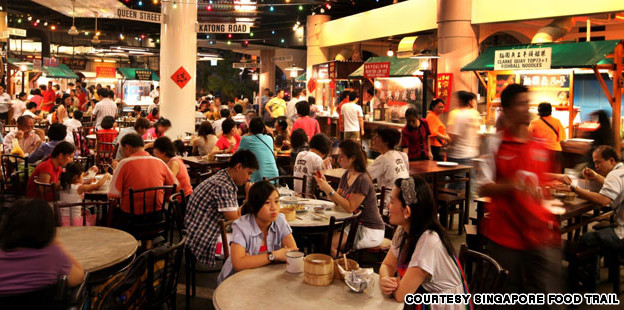
An example of a food court in Singapore.


Famous foods in Singapore. Singapore is a popular tourist destination for its amazing food.


The unique tropical fruits of Southeast Asia.

I've learned that my culture is very inclusive in terms of racial diversity. However, it can be less inclusive in terms of socio-economic status. Additionally, the education system can be pretty brutal, and students are separated into different learning proficiency streams as young as ten years old. I want to create a classroom that encourages and enables better classroom learners to help their fellow peers. I recognize that everyone is gifted in their own ways and have different talents to offer. I grew up in a system that placed a daunting emphasis on formal education and how well you performed in it. Young people end up seeing each other in a different light determined by the proficiency streams they are placed in, however unintentional this judgement. I want my students to discover that there is so much more to learning and being a contributive person to society that is absolutely not solely determined by how well you perform in the classroom of formal education.

Monday, October 5, 2015

Being the "Other"

So I started out with a different introduction 'paragraph' which I have moved to the end of this post. Let's just say, this assignment turned out a little trickier than I thought because I realized that my entire experience at BYU really has been - being the "Other".

But as I thought more about it, well at the end of the day, the one thing that I do have in common with my peers is the very thing that brought us all, well, most of us here - being Mormon. So I decided, for the first time in my life, to attend another church to see what it was like.

I picked the First Unitarian Church of Salt Lake City. I was surprised at how intimidated I felt when I walked in, not because people were mean or unkind at all, but because I was worried about what they would think of me if they knew I was still Mormon. Prior to attending that Sunday, I had heard that this Church was very inclusive and that a lot of people who had left the Mormon church would attend here.

As I proceeded to look for a place to sit, it didn't help that, being racially different, I already stood out pretty fast (as I often do here) as much as I tried to place myself as quietly and inconspicuously along the side of the room. I could tell people were looking at me, although most of it would quickly turn to smiles.


What troubled you about the experience?

The service was definitely different in that it was more varied, a little less formal (though still reverent I'd say), and different kinds of people went up and expressed themselves to the congregation and God in different ways. I will say, I had a lot of apprehension the entire time, yet at the end of it, I remembered that just because something is different doesn't mean it's wrong. I knew I was uncomfortable because I have always experienced church in a very distinct and separate way. And the manner of our Church was so ingrained in me, that's why they say, being Mormon will always be in my DNA. Yet the experience was so troubling for me is that I've been so wired to believe that we are the ONE TRUE CHURCH. So even though I was welcomed at this other church, I constantly felt guilty for thinking that it didn't feel completely right to be there because they don't have the full gospel - even if they were good people. Whether people noticed that I seemed uncomfortable or not, it didn't matter because afterwards, people came up to me and they were really friendly and I really appreciated it. People who did not look like what my Mormon church often taught me about what 'good' people looked like, were so happy and sincere in their interactions.

This experience made me think back to an interesting thought I had a while ago. My friend Nicol came to BYU as a non-member student to attend the accounting program here. She was a Christian of a different denomination at the time and was not required to attend our church services on Sunday. However, she could not find her church here. Yet because she simply felt like she needed and wanted to be in a church on Sunday to worship God, she chose to attend a student ward anyway as much as she had her own reservations about Mormonism. This made me realize that in contrast, for Mormons, if we can't find our church in a place we are in, we just don't go.

So I might have gotten side-tracked a little bit. Well, I definitely felt out of place there but I coped by making an effort to engage in conversation with people - as I have always tried to do. I also try to remind myself that a lot of the situations where I am the "Other" is very circumstantial - like if you were a White American kid attending school in Asia. (But there are also a lot of situations where it's not circumstantial and the response is a result of people's upbringing and life experience, and they just don't know how to react with and to you).


What insights can you take into your future work as a teacher?

Through this and many other experiences of being the "Other", has really allowed me to gain empathy for others. And it has only made me want to make my future classroom a safe, inviting, normalized, and inclusive space for my students to express themselves regardless of how different they are from each other. I want my students to know that being different is what brings us together - being different is beautiful because it opens your mind and gives you new perspectives in life.


(Also, I do not have pictures because I was too nervous/anxious/scared to take any while I was there.)


Here's the former little intro of how I've lived as the "Other" in both being at BYU and even before I came to BYU really.

1. Being a non-white
2. Being a non-American/international student/foreigner
3. Being biologically assigned female at birth
4. Identifying as an agender individual
5. Being attracted to others of my same biological sex (however few of them)
6. Not looking and carrying myself like the most other females at BYU/in the church
7. Being the only Asian female who play intramurals basketball at BYU
8. Being an Asian female in the film program
9. Just having to go to the bathroom being an anxiety-ridden experience because you don't 'look' like you belong in there and other women do a double-take when you go in.
10. Wearing pants to church on Sunday because that's why I feel most comfortable in even though people stare (and think you're trying to make a statement).

I chose to include this in the end because it made me also think of the ways I am not the other:

1. I have friends
2. My roommates know I'm an LGBT individual and they are still nice to me
3. I have siblings and we love each other
4. I am in college
5. I am not homeless
6. I do not have to beg on the streets for a living
7. My apartment is warm and the roof is not leaking
8. I have clean clothes to wear to school everyday (if I do my laundry)
9. My professors like me

10. I am grateful to have a natural friendly disposition that allows people to feel like they can come talk to me

Monday, September 21, 2015

Cultural Snapshot


Trailer: https://www.youtube.com/watch?v=BB5ag2hswmo


An underprivileged group that I feel has been misrepresented in our society is the Deaf population and community.

The cultural snapshots I have collected illustrate that there is SO much that is still misunderstood about this community, how inaccurate the representations are of Deaf people in main stream culture and in the media, and how Deaf people are still constantly having to find ways to educate the public.

What message(s) (consistent or conflicting) are being sent about this cultural group through these artifacts? Illustrate how the artifacts convey the message(s).

The artifacts represent a lot of misconceptions such as cochlear implants being the way to 'fixing' Deaf people, why/how people are Deaf, how they feel, and what they are capable of. These various artifacts show that people still think that Deaf people are deaf because/only because of loud noises, that they miss being able to hear or rather, they wish they were able to hear, and finally, people think they aren't as intelligent or competent as others owing to their inability to hear.

The film artifact featured is particularly terrible. Though made only fairly recently in a time where you'd think people were already be more informed and less ignorant, the trailer itself perpetuates a lot of the stereotypes that Deaf people are 'less than' and act differently even though the ONLY thing different about them is that they can't hear.

How might this message(s) impact how a child from this cultural group is viewed and treated in the classroom? 

So some of the messages collected from these artifacts are more negative, and some more positive than others. Regarding the negative messages, a lot of students might wonder why a fellow deaf or hard-of-hearing student does not have/did not want to get a cochlear implant. They may also think that the student is not smart as them because he/she may have speech difficulties or sound different. Regarding the positive messages, a child may hopefully be treated as an equal in the classroom.

Why is it important for teachers to examine how cultural groups are represented in the media, curriculum and policy?

I feel it is important for teachers to examine how these cultural groups are represented in the media, curriculum, and policy because it enables them to be aware of how their students of various demographics are perceived by their peers in the classroom. In doing so, they can then take steps to ensure that their classroom is one that is inclusive, and that their students become educated and informed in the kind and respectful ways they ought to treat their peers.

Sunday, September 20, 2015

Imagined Classroom

1. Five images (you can take them or they can come from the Internet [provide proper credit]). These images should reflect, in some way, what you imagine your classroom will look like once you are a teacher. Please annotate your images by providing a description of the image and how it relates to your future classroom.

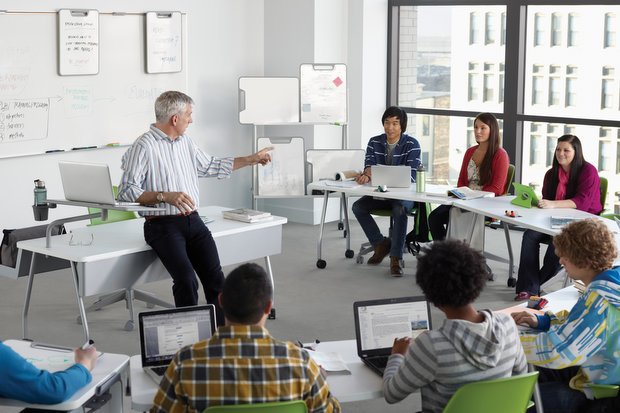
Picture 1: Classroom has many windows. Each student has a computer so they can easily see and refer to what the teaching is saying. The desk is also big enough for them to write notes for any thoughts and ideas they might have during instruction.


Picture 2:  There is sufficient space in between the grouped tables and chairs for the teacher to walk around and work with the students freely. The grouped spaces allow students to also collaborate with ease.


Picture 3: The teacher can easily see everyone. The small teacher to student ratio allows me to know each of my students more personally and allows me to reach out to them.


Picture 4: I love the image of the globe on the floor. The open space and chalk boards creates a welcoming place for young energetic students to walk about freely to discuss ideas. This space would be used as a discussion haven. Many young students think with more clarity when they are able to move about.


Picture 5: I would love to have an outdoor section of my classroom where students can also just go outside on good-weathered days to continue learning. Nature is also another ‘culture’ which students can learn more about. When student can become more aware of nature and see what is at stake, it helps them become more aware of what they are doing day to day that impacts nature. The fresh air from the outdoors can also help students to focus better because very often young people just want to be outside moving around and not just stuck indoors for long periods of time.


2. Imagine the surrounding in your classroom. What does the room look like? What resources are available for students? How are the resources used during the lesson?

The room has many windows. There are computers and learning tablets. They are used for looking up additional information that will enhance the lesson, or empowering students to share things they have already come across that are relevant to what is being taught. The room has walls with special whiteboard texture/paint that students can write on. There is something marvelous and magical about being able to draw and write on walls.


3. Describe the students in your classroom. What are their backgrounds? What are their interests? What are they doing during the lesson?

The students in my class are happy and enthusiastic. They come from a diverse combination of race, language, religion, economic status, family backgrounds and cultural traditions. They are interested in a unique combination of things arts, science, language, technology, sports, and play. They are learning how to express their thoughts, ideas, and dreams during my lesson, while doing so in a kind and respectable manner towards their peers.


4. Describe your classroom policies. What are you classroom rules? What is your discipline plan? What are your homework policies?

Students will be patient, kind, and respectful to each other.
Students will participate and contribute to class discussions.
Students will gather and return materials to the right places, and clean up after themselves.
Students will be focused when in the classroom, speak only when appropriate, and show sincere effort in completing their own work.
Students will be punctual to class.

--------

If a student is late more than three times, he/she will stay after school for 15 minutes to help the teacher clean and organize the classroom. Ten minutes will be added to each additional tardiness.

Verbal warnings will first be given for excessive talking or disrupting the class. After three times, a student’s seat will be changed, followed by a timeout in the classroom, and then in an alternate classroom.

If bullying is detected, a verbal warning will be given. If it happens again, a visit to the Principle’s office and possible contact with the student’s parents will result.

--------

Homework can be turned in late but at a 50% deduction penalty for everything up till a week before the last day of class. Homework can also be redone for a single letter upgrade.


5. Describe a typical lesson you will teach in your classroom. What will you teach? What is the topic? Why did you choose this topic? How will you teach it? What is the main thing you want students to learn during this lesson?

Ideally I will teach film. I will teach my students how to make documentaries. The topic is telling stories about social issues or stories that are important/personal to them. I chose this topic because stories about misunderstood, marginalized, and minority groups need to be told. I want students to give voice to the voiceless and this can either be themselves or someone they know, or even some part of life they didn’t even know they could talk about. I will teach it using examples of past documentary films, then getting students to hash out their ideas, draw storyboards, learn how to use a camera, and finally learn how to edit their footage. I want students to learn that everybody has a story, and to also learn that if you’re going to make something, you might as well make something good because that is why we are given the tools and talents that we have.


6. Imagine your work as a teacher during this lesson. What are you doing during the lesson?

I am constantly engaged with my students. I ensure that I am speaking loudly, and clearly enough, and always in a respectful manner. I also ensure that I make myself as readily as possible during the time that students are working on their films.


7. Imagine your students again, what are they doing during the lesson?

My students are listening. They may be writing, or doodling but they are tuned in and listening. They are coming to me with questions. They are working on their stories. They are learning. They are smiling. They are interested.


8. Imagine how you will assess your students' learning and achievement. How will you know they have learned?

I think one of the best ways is to have students talk about the work they have done - that way you can gain a pretty good idea about how invested they were in it. I would like them to talk about what they loved, what worked for them, and what they did not like about the assignment. I would also like them to share with the class one thing they were surprised to learn.